
Physical connectors as an attack surface
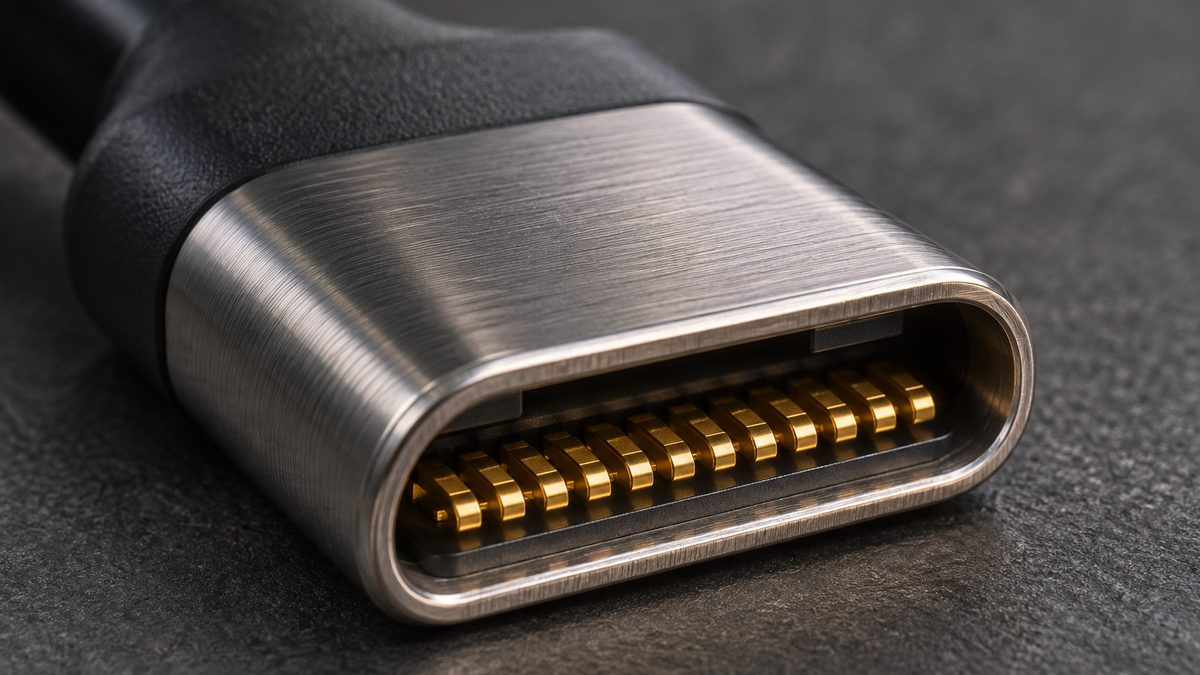
Designers tend to think of a charging connector as a power feed. Attackers think of it as a door with a known location, a standard shape and, very often, more wires behind it than the user realises. On wearables, handhelds, scanners and similar small devices, the few contacts used for charging and docking can be the most exposed part of the product.
Data hiding behind a charge connector
Spring-loaded contacts, magnetic connectors and small USB receptacles are chosen for their size and durability. Many carry more than two power pins. Extra pins may serve a data link to a cradle, a battery gauge, a factory programming interface or a serial console. If those lines are live on the shipped device, anyone who can touch the contacts, or build a matching dock, may be able to talk to the main processor. A cheap lookalike cradle is easy to make once the pinout is known, and pinouts are easy to learn by measuring a single device.
Debug reachable through the cradle
A particularly common weakness is a debug or boot-mode interface multiplexed onto a pin that is also used for charging or docking. The reasoning at design time is that the pin is only reachable inside the factory fixture. In practice the same contact is exposed to the world. If a specific voltage level, pin state or timing sequence switches the pin into debug or bootloader mode, an attacker can reproduce it. Mode-select behaviour should be disabled by fuse in release firmware, not only hidden by the connector.
USB attack classes
- Juice jacking. A public charging port, or a compromised cable, tries to exchange data with a phone or handheld that is only meant to be charging. The defence is data-blocking on charge-only connections and requiring explicit user approval before any data session starts.
- Malicious HID. A device that presents itself as a keyboard can type commands at machine speed. Hosts that trust any new input device accept it immediately. Embedded products with a USB host port should restrict which device classes they enumerate.
- Malformed descriptors. USB stacks parse data supplied by the other side. Flaws in that parsing in the firmware or bootloader can give code execution before any authentication takes place.
- Mass storage and firmware update modes. A device-firmware-update mode reachable over USB without signature checks lets an attacker replace the firmware.
Fault injection through power pins
The supply is also an input. Short, deliberate dips or spikes on a power or charge pin can cause a processor to skip an instruction or misread a value, which is how some attackers defeat a signature check or a lock bit. A connector that gives direct access to the core supply, or to a rail without filtering, makes this easier. Series filtering, brown-out detection, voltage monitors and proper regulation between the contact and the chip all raise the cost of the attack.
Design review questions
| Question | Why it matters |
|---|---|
| Which pins carry data, and what protocol runs on them? | Unknown data lines are unexamined attack surface |
| Are those lines gated off in the shipped firmware mode? | Factory functions should not survive into the field |
| Is debug or boot-select muxed onto a charge or dock pin? | Hidden mode entry is reachable from outside |
| What happens if an unauthenticated device is on the other end? | Tests the cradle-spoofing case |
| Is there ESD and overvoltage protection on every external pin? | Protects against damage and limits glitching |
| Is the supply filtered and monitored before the processor? | Makes power-pin fault injection harder |
| Does USB restrict device classes and require signed updates? | Closes the HID and update-mode routes |
Work through the table with the schematic open and then confirm each answer on a real shipped unit with a meter and a logic analyser. The connector is the first place a reviewer outside the team will look, so it should be the first place the design team does.
Key takeaways
- Charge contacts often carry data or debug signals; list what every pin does.
- Do not mux debug or boot-select onto pins reachable from outside the case.
- USB hosts and devices should restrict classes and require signed updates.
- Filter and monitor power pins to make glitching harder.
- Verify each answer on a real production unit.